
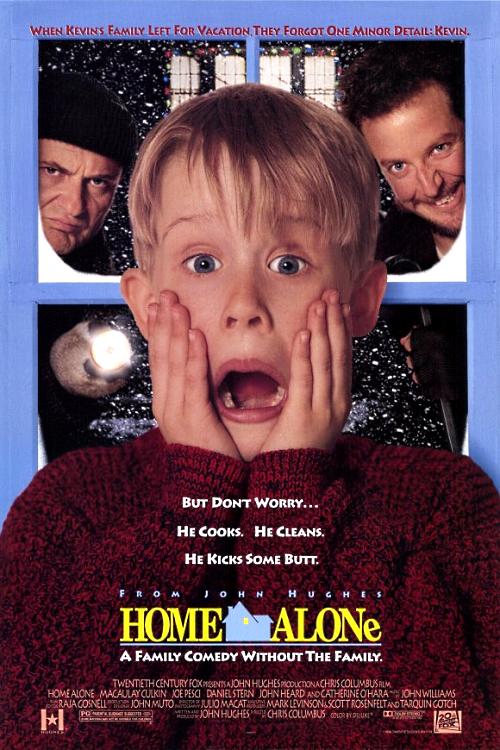
How to Write Home Alone
by L.A. Zvirbulis
1 – The Inspiration. Plan a vacation with your spouse. List off all the things you need to pack, and realize how funny it would be if you forgot to pack one of your children. Hilarious. Write a movie about it because you’ve already written several other successful films and let some guy named Chris Columbus direct it. Not the guy that initiated the destruction of the Native Americans, but the guy that wrote Gremlins, The Goonies, and goes on to direct Mrs. Doubtfire and two Harry Potter films. Very different Chris.
2 – The Genre. Family Holiday movie. Make sure every frame of the movie looks like a Christmas card. Place it in the same suburb that you use in all of your movies because it snows in Chicago and snow is necessary for a Christmas movie in the Northern Hemisphere. Christmas movies need to be cold and white and red and green.
3 – The Complications. What’s the worst that could happen? Your child is left home alone. By you. And if that doesn’t make you feel like a bad parent, your child befriends the town’s alleged murderer and then is attacked by burglars while they invade your house. Pretty much a parent’s worst nightmare. At least you didn’t leave the garage door open. Oh wait, you did. At least the last time you saw your son – Kevin? Yeah, that’s the one – he only likes cheese pizza – got at least one slice of cheese pizza on the last night you spent alone together, yes? No? Wow, parents. Just wow. Enjoy your flight to Paris.
4 – The Fun Stuff. A kid takes care of himself and and acts as your home security system while you vacation in Paris. Let Kevin really torture these silly burglars better than any silly alarm or security company could do. We can get violent, because of the cartoon-like innocence of actor Macauley Culkin and the over the top acting from the bad guys. We want Kevin to really beat up these terrible middle-aged men, so a blowtorch to the head, an iron on the face, and an ancient feather torture technique will play well with the audience. We giggle at the violence. These bad guys steal stuff on Christmas. That’s bad. But what’s good is that we can get John Williams to compose the score after he is enchanted by a rough cut of the film.
5 – The Old Man. Kevin isn’t completely alone because he meets the weird old man who supposedly murdered his own family! I mean the weird old man did figuratively murder his family by estranging himself from his son, but Kevin helps him with that. The old man also comes in handy when the bad guys get really bad and he comes to save the day with a shovel! It’s good to have old friends.
6 – The Burglars. We need bad guys who have a sense of humor. Well, they can carry the comedy necessary to handle all of the violence we put upon them. Do you think I’m funny? Yes, I do, Joe Pesci and Daniel Stern. Also, Joe, when you have the urge to use the “f” word, can you choose “fridge”? This isn’t Goodfellas, so you need to be a good fellow. And we pay Stern his asking rate because he’s the voice of Kevin on the hit tv show The Wonder Years and has a great agent. He’s also a talented actor who has better chemistry with Joe than that first actor we hired and had to replace with Daniel.
7 – The Jokes. Thank goodness you got your first job as a joke writer for an ad agency, then lampooned jokes for a national magazine before writing several successful feature films. The audience liked your jokes then, and you prove yourself over the next twenty years of your comedy movie writing career, even under the pseudonym “Edmund Dantes” as a not-so-subtle Count of Monte Cristo reference when you write the Jennifer Lopez movie Maid in Manhattan but don’t want to be seen next to it. Busted, John Hughes! Now everyone knows.
8 – The Title. Home Alone. It’s simple and to the point and the audience can drink their eggnog when the burglars realize that the kid is “Home Alone”, thus obeying the first rule of movie drinking games – drink when a character says the name of the movie. Make sure to provide non-alcoholic eggnog for the children in the audience. This is a family drinking movie. Also, let’s make kids feel alone in their own homes, so make sure we never actually see Kevin’s room. Weird, right?
9 – The Ending. Kevin gets his family back on Christmas after defeating the bad guys. This is a family film, after all, so of course the kid survives. We need him for the sequel. We also need the bad guys for the sequel, so thank goodness no one dies in this violent yet family-friendly movie. Mom takes a road trip with a Polka band and John Candy, which is punishment enough, because, you know, polka sucks. At least John Candy is good friends with our mom actor Catherine O’Hara from their Canadian improv days, so we can let John Candy improvise these scenes. We only get him for 23 hours anyway, but it’s kind of a thing to put him in movies you’ve written lately. The rest of the family shows up three minutes later after waiting for that direct flight, kind of rubbing it in mom’s face for taking a rough road trip. The mom really gets punished for leaving her son home alone. The dad, not so much, even though he is the one that throws away Kevin’s airline ticket.
10 – The Heart. Family matters. Kevin learns that he actually loves his family and wants them around, no matter how insulting or annoying they are. Being Home Alone is far worse. But he did it. He survived unharmed and didn’t burn the house down. What a tough kid. You know what, I think we can take another family vacation next year.
*L.A. Zvirbulis did not write Home Alone. John Hughes did.
 How To Write Your Favorite Movie